Ievads
This manual provides detailed instructions for the safe and efficient operation, maintenance, and care of your Ford 345C, 445C, and 545C Tractor Loader. Familiarize yourself with all sections to ensure proper use and to prolong the life of your equipment. Always keep this manual accessible for reference.
The information contained herein is based on the latest product data available at the time of publication. Specifications and designs are subject to change without notice.
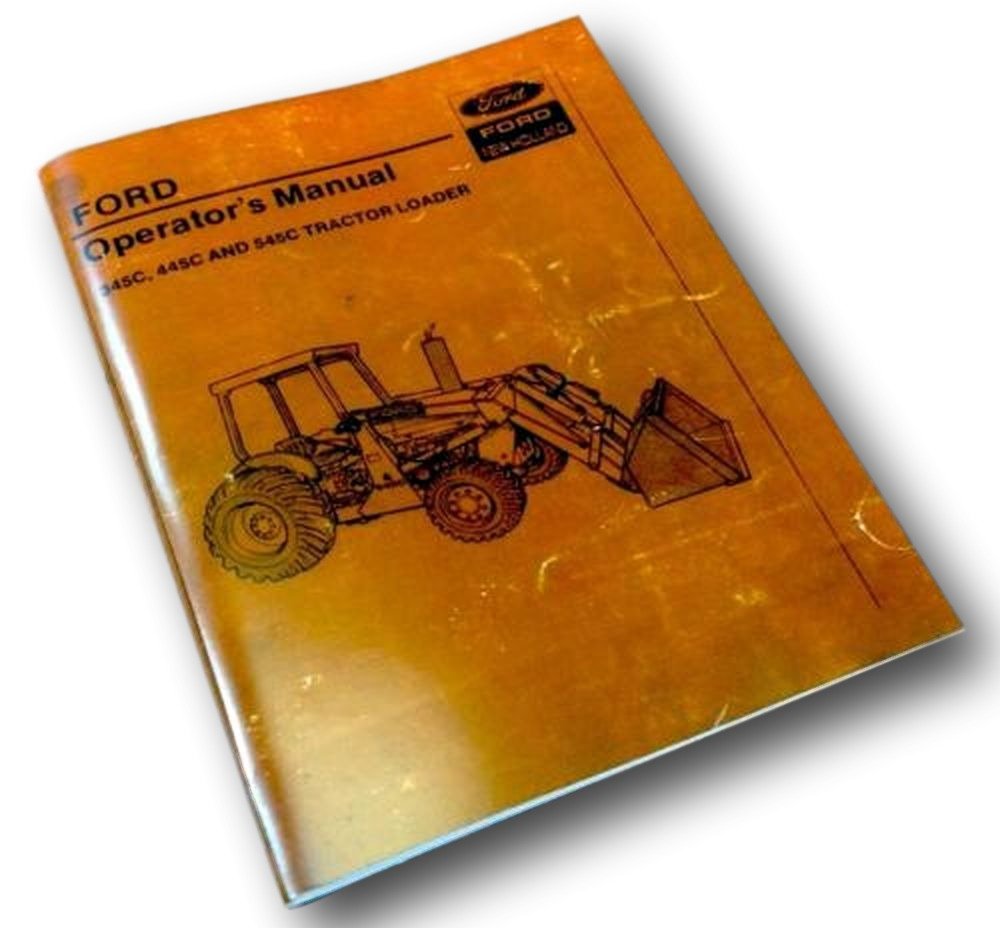
1. attēls: An open page from the operator's manual, illustrating the detailed content and diagrams provided for various operational aspects of the tractor loader.
Drošības pasākumi
Operating heavy machinery requires strict adherence to safety guidelines to prevent injury or damage. Always read and understand all safety warnings and instructions before operating the tractor loader.
- Roll Over Protective Structures (ROPS): Ensure ROPS are properly maintained and never modified. Always wear your seat belt when operating a tractor equipped with ROPS.
- Universal Symbols: Familiarize yourself with all universal safety symbols found on the machine and in this manual. These symbols provide critical warnings and instructions.
- Pārbaudes pirms ekspluatācijas: Before each use, perform a thorough inspection of the tractor loader, including fluid levels, tire pressure, and the condition of all controls and safety devices.
- Droša darba vide: Operate the machine only in well-lit areas, free from obstructions and unauthorized personnel. Be aware of your surroundings, especially when working on slopes or uneven terrain.
Controls, Instrument and Operation
This section details the location and function of all controls and instruments necessary for operating your Ford 345C, 445C, or 545C Tractor Loader.
Instrumentu panelis
The instrument panel provides vital information about the tractor's status, including engine speed, fuel level, temperature, and warning indicators. Regularly monitor these gauges during operation.
Hand Controls and Switches
Various hand controls and switches manage functions such as lights, wipers, and auxiliary hydraulic circuits. Refer to the specific diagrams in the full manual for precise locations and functions.
Dzinēja iedarbināšana un apturēšana
- Key-Start/Stop Switch: Insert the key and turn to the 'ON' position. For starting, turn further to 'START' and release once the engine fires. To stop, turn the key to 'OFF'.
- Ensure the transmission is in neutral and the parking brake is engaged before starting.
Kāju vadības ierīces
- Clutch Pedal: Used to disengage the transmission for gear changes. Depress fully for smooth engagement.
- Brake Pedals: Independent pedals for left and right wheel braking, or combined for simultaneous braking.
- Akseleratora pedālis: Kontrolē dzinēja ātrumu.
Stāvbremze
Engage the parking brake whenever the tractor is stationary, especially on inclines, to prevent unintended movement.
Pārnešana
The tractor loader may be equipped with different transmission types:
- Non-Synchromesh Transmission: Requires double-clutching for smooth gear changes.
- Fully Synchronized Transmission: Allows for easier gear changes without double-clutching.
- Synchronized Power Reversing Transmission: Enables quick and smooth directional changes (forward/reverse) without stopping.
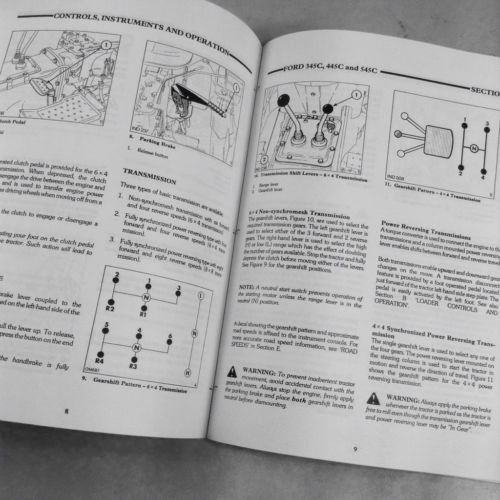
2. attēls: Detailed diagrams illustrating the clutch pedal, parking brake mechanism, and various gearshift patterns for the Ford 345C, 445C, and 545C Tractor Loaders. This includes visual guides for non-synchromesh, fully synchronized, and synchronized power reversing transmissions.
Other Controls and Adjustments
- Front Wheel Drive Option: Engage or disengage as required for traction.
- Running-in Procedure: Follow the recommended running-in procedure for new engines to ensure optimal performance and longevity.
- Sēdekļa regulēšana: Adjust the operator's seat for comfort and optimal control access.
- Drošības josta: Always wear the seat belt when operating the tractor.
- Independent Power Take Off (PTO): Controls the engagement and disengagement of the PTO for operating implements.
- Hydraulic System Controls: Levers and switches for managing hydraulic flow to various implements.
- Rear Wheel Track Adjustment: Adjust the rear wheel track width for stability and specific operational needs.
- Tractor Weighting: Proper weighting is crucial for stability and traction, especially when using heavy implements.
Loader Controls and Operation
This section focuses on the specific controls and operational procedures for the front-end loader attachment.
Loader Control Lever
The main lever controls the raising, lowering, tilting, and dumping actions of the loader bucket. Operate smoothly to avoid sudden movements.
Loader Bucket Level Indicator
A visual indicator helps the operator determine the bucket's angle relative to the ground, aiding in precise material handling.
Hydro-Mechanical Self-Levelling
This feature helps maintain the bucket's angle as the loader arms are raised or lowered, reducing spillage and improving efficiency.
Transmission Dump Switch
Temporarily disengages the transmission when pressed, allowing full engine power to be directed to the loader hydraulics for faster cycle times.
Loader Bucket Installation
Follow the manufacturer's instructions carefully for safe and secure installation and removal of the loader bucket.
Loader Operation
When operating the loader, always maintain a low center of gravity, avoid overloading the bucket, and be aware of overhead obstructions. Distribute loads evenly.
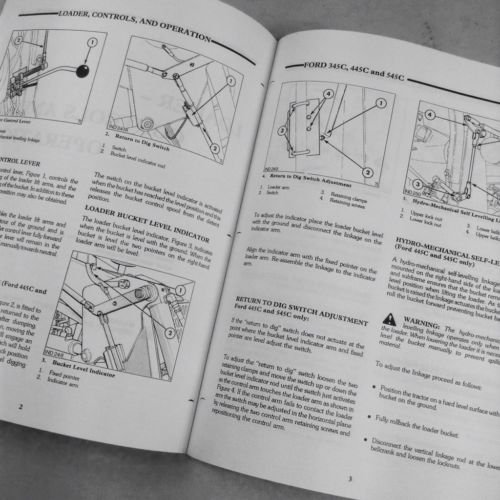
3. attēls: Diagrams illustrating the loader control lever, the 'Return to Dig' switch adjustment, and the hydro-mechanical self-levelling system for the Ford 345C, 445C, and 545C Tractor Loaders. These visuals aid in understanding the precise operation of the loader functions.
Hydraulic Lift and P.T.O. Controls and Operation
This section covers the operation of the tractor's hydraulic lift system and Power Take-Off (PTO).
Hidrauliskā sistēma
The hydraulic system provides power for the three-point linkage, remote cylinders, and other hydraulic implements. Ensure hydraulic fluid levels are correct and use the specified fluid type.
Operating Remote Cylinders with A.S.C. Valve
Instructions for connecting and operating remote hydraulic cylinders, often used for implements like trailers or plows, especially when equipped with an Automatic Sensing Control (A.S.C.) valve.
Remote Control Valves
Levers and controls for directing hydraulic flow to external implements connected via remote couplers.
Three Point Linkage
Details on attaching and adjusting implements to the three-point linkage system, including proper pin selection and leveling procedures.
Independent Power Take-Off (PTO)
How to engage and disengage the independent PTO shaft, which provides power to rotary implements such as mowers or tillers. Always ensure the PTO guard is in place.
Eļļošana un apkope
Regular lubrication and maintenance are critical for the longevity and reliable performance of your tractor loader. Adhere to the recommended service intervals.
- Ikdienas pārbaudes: Inspect fluid levels (engine oil, hydraulic fluid, coolant), tire pressure, and general condition.
- Servisa intervāli: Follow the detailed lubrication chart and maintenance schedule provided in the full manual for engine, transmission, hydraulic system, and chassis components.
- Filtra nomaiņa: Regularly replace air, fuel, oil, and hydraulic filters to prevent contamination and ensure optimal system function.
- Tīrīšana: Keep the tractor clean, especially around the engine and radiator, to prevent overheating and corrosion.
Specifikācijas
This section provides key technical specifications for the Ford 345C, 445C, and 545C Tractor Loaders. For a complete list of detailed specifications, refer to the comprehensive manual.
- Dzinēja tips: Diesel, typically 3-cylinder or 4-cylinder, depending on model.
- Zirgspēki: Varies by model (e.g., 345C, 445C, 545C indicating power levels).
- Pārnešana: Options include non-synchromesh, fully synchronized, or synchronized power reversing.
- Hidrauliskā sistēma: Open-center or closed-center, with specific flow rates and pressure.
- Degvielas tvertnes tilpums: Specific to each model variant.
- Darba svars: Varies significantly based on model, attachments, and ballast.
Drošības uzlīmes
Safety decals are strategically placed on your tractor loader to provide immediate warnings and instructions. It is crucial to:
- Izlasi un saproti: Familiarize yourself with the meaning of each decal.
- Uzturēt redzamību: Keep decals clean and legible. Replace any damaged or missing decals immediately.
- Never Remove: Do not remove or obscure any safety decals.
Problēmu novēršana
This section provides basic troubleshooting steps for common operational issues. For complex problems, consult a qualified service technician.
- Dzinējs neiedarbojas: Check fuel level, battery connections, and ensure the parking brake is engaged and transmission is in neutral.
- Hidrauliskās jaudas zudums: Check hydraulic fluid level, filter condition, and ensure PTO or hydraulic pump is engaged.
- Pārkaršana: Check coolant level, radiator cleanliness, and fan belt tension.
- Neparasti trokšņi: Investigate immediately. Stop operation and identify the source of the noise.
Garantijas informācija
Warranty details for your Ford 345C, 445C, or 545C Tractor Loader are typically provided at the time of purchase. Please refer to your warranty document for specific terms, conditions, and coverage periods. Keep your purchase receipt and any warranty registration documents in a safe place.
Atbalsts un serviss
For technical assistance, parts, or authorized service, please contact your local Ford dealer or an authorized service center. When contacting support, have your tractor's model and serial number readily available.
- Pilnvarotie izplatītāji: Locate your nearest authorized dealer for genuine parts and expert service.
- Tiešsaistes resursi: Additional support and parts catalogs may be available on the official Ford agricultural equipment webvietne.


